

In the previous blog, you read about two of the four psychological pillars of investing. This blog discusses the remaining two pillars: Attention and Emotion. (The ideas are from the insightful talk, The Rewards of Good Behaviour, by Sanjoy Bhattacharyya)
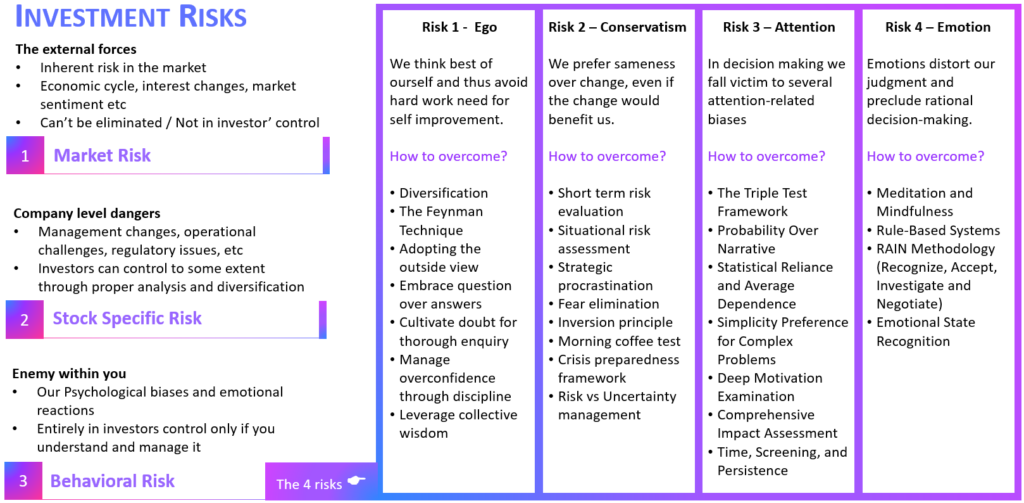
Focusing ATTENTION: Signal vs. Noise Mastery
The fundamental attention issue lies in the fact that salience trumps probability when investment decisions are made. This leads investors to rate unfamiliar opportunities as more risky while showing preference for familiar investments regardless of their fundamental qualities.
The Triple Test Framework
Any investment idea that merits serious consideration must pass a rigorous triple test that serves as the ultimate filter for serious investment consideration:
-
- Strong empirical support must be demonstrated through historical data validation
- A sound theoretical foundation must underpin the empirical evidence with logical reasoning
- Stubborn behavioral roots must ensure the pattern’s persistence over time, making it difficult for the phenomenon to change due to its grounding in human psychology
Probability Over Narrative
The odds should be planned while the story is ditched. Compelling narratives often obscure fundamental realities and lead to poor investment decisions. Stories, particularly scary ones, stick in memory better than percentages, but percentages provide more reliable guidance.
Statistical Reliance and Average Dependence
Averages should be relied upon rather than outliers or exceptional cases that capture attention but misrepresent typical outcomes. Our brains naturally recall the exceptionally common and the exceptionally strange more easily than moderate, representative cases.
Simplicity Preference for Complex Problems
Simple solutions should be sought for complex market problems, as overcomplication often leads to analysis paralysis and poor execution. Complex dynamic problems typically require simple, focused solutions rather than elaborate frameworks.
Deep Motivation Examination
The deepest motivations behind thoughts and actions must be examined consistently, while feedback should be sought from those with diverse viewpoints to challenge assumptions and prevent confirmation bias.
Comprehensive Impact Assessment
Both the likelihood of an event and the intensity of its impact are important considerations that must be weighed simultaneously. While the default strategy state should be bullishness, contingencies must be included for low-likelihood, high-intensity events that could devastate unprepared portfolios.
Time, Screening, and Persistence
Sufficient time should be given to screen out weak ideas, maintain appropriate diversification, and persist with time-tested principles despite short-term failures. Information overload often leads to paralysis or inadequately thought-out decisions, making patience a crucial virtue.
Signal vs. Noise Mastery
The real challenge involves distinguishing between signal (information that is additive and meaningful) and noise (red herrings that provide false sense of belonging). People often trade on noise rather than signals because noise creates community and belonging, even though it leads to poor investment outcomes.
Managing EMOTIONS: The RAIN Methodology
Strategies to Cope with Emotions
Rather than fighting emotions, they should be channeled productively using the principle of “don’t beat it, join it.” The tendency toward inaction can be made to work in your favor by locking in desirable behaviors once and effectively forgetting about them through systematic approaches. This involves using concepts like bonus versus rebate psychology and proper labeling of behaviors to create sustainable habits.
The Power of Meditation and Mindfulness
Rules-based systems should be followed consistently in all types of market weather because our ability to control impulsive behavior in emotionally charged moments is typically overestimated. Automation prevents emotional hijacking of logical processes and ensures consistent execution of proven strategies.
The RAIN Methodology
When emotional states threaten rational decision-making, the RAIN methodology should be implemented systematically:
Recognize: The specific emotions flowing through your mind must be identified—whether fear, anger, panic, or euphoria. Emotional awareness is the first step toward emotional control.
Accept: The emotion should be acknowledged without judgment. Instead of fighting the feeling, simply recognize: “Right now, I am experiencing fear” or “I am currently feeling panicked about this market movement.”
Investigate: The underlying causes of the emotional response must be explored. Questions like “Why am I reacting this way?” and “What specific triggers are causing this emotional state?” should be asked systematically.
Negotiate: Delay action while you negotiate internally. Focus on learning from the experience and developing strategies to prevent similar emotional hijacking in future situations.
Emotional State Recognition
Your emotional state must be learned to be recognized, and its impact on risk and opportunity appraisal must be understood. Different emotional states create different risk perceptions, often leading to suboptimal investment decisions when emotions run high.
Conclusion
Overcoming psychological barriers to successful investing requires systematic implementation of proven strategies and unwavering discipline. By implementing diversification to combat ego, embracing calculated risks to overcome conservatism, focusing on signal over noise to sharpen attention, and using the RAIN methodology to manage emotions, investors can transform psychological liabilities into competitive advantages. The most successful investors are those who have developed systematic approaches to recognize and overcome these barriers when they arise.
Hope you found this blog useful. Do share my blogs with your friends, peers and fellow investors.


