

In the world of investing, most discussions revolve around technical charts or financial ratios. Yet, the most overlooked—and arguably most influential—factor is investor psychology behind financial decisions. In his insightful talk, The Rewards of Good Behaviour, Sanjoy Bhattacharyya, Managing Director of Fortuna Cap, highlights why behavioural finance isn’t just academic theory, but a practical framework that can make or break your investment success.
Drawing on the wisdom of behavioral experts like Daniel Crosby, Jason Zweig, James Montier, and Michael Mauboussin, Sanjoy Bhattacharyya explains how psychological traps silently shape our decisions. This blog goes beyond summarising his speech—it blends his insights with my own reflections and investing experience. We will explore four key behavioural pitfalls every investor must navigate: Ego, Conservatism, Attention, and Emotion.
In the next blog, will provide actionable ideas shared by Sanjoy Bhattacharyya on how to overcome these biases and build stronger investing habits.
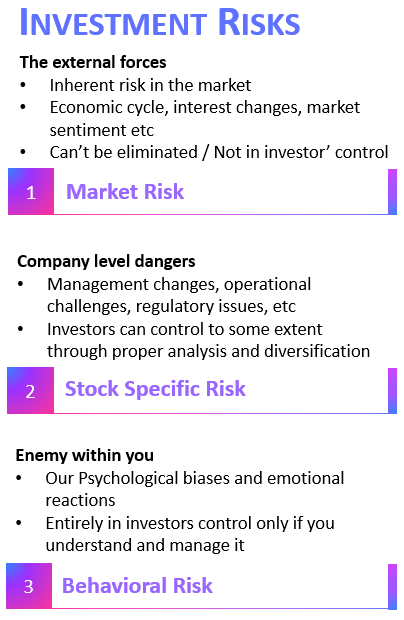
The Three Types of Investment Risk
Market Risk: The External Forces
- This is the risk inherent in market movements—economic cycles, interest rate changes, and broad market sentiment.
- While you can’t eliminate market risk, you can prepare for it and position yourself to benefit from market dislocations.
Stock-Specific Risk: Company-Level Dangers
- This involves risks specific to individual companies—management changes, competitive threats, regulatory issues, or operational challenges.
- Thorough research and diversification can help manage this risk category.
Behavioral Risk: The Enemy Within
- This is the risk you create through your own psychological biases and emotional reactions.
- Unlike the first two categories, behavioral risk is entirely within your control—if you’re willing to do the work to understand and manage it.
This Behavioural risk is the key theme of this and the next blog. Sanjoy Bhattacharyya discussed about 4 behavioral risk that we will discuss in this blog.
Behavioral Risk 1 - EGO
The Nature of Ego in Investing
Our ego drives us to think the best of ourselves while avoiding the hard work required for genuine self-improvement. This manifests in several dangerous ways:
- Confirmation bias: We actively seek supporting evidence for our existing beliefs
- Self-congratulation: We pat ourselves on the back for our investment philosophy, regardless of results
- Defensive reactions: We react violently against any attacks on our worldview
- Dunning-Kruger effect: Those with limited knowledge fail to recognize their lack of skill, while experts sometimes cannot accept uncertainty
The Overconfidence Epidemic
Overconfidence represents one of the biggest sources of investing errors in history. It stems from the dangerous belief that we know better than others in the market. This ego-driven approach leads to several critical mistakes:
- Seeking validation: Instead of challenging our ideas, we call analysts who share our views
- Aspiring beyond our means: We want to be Warren Buffett without possessing his temperament or intellect
- Avoiding disconfirming evidence: We fail to actively seek information that contradicts our investment thesis
Behavioral Risk 2 - CONSERVATISM
The Comfort of Sameness
Human nature drives us to prefer sameness over change, even when change would benefit us. This preference exists because change requires cognitive effort and carries the potential for loss and regret—outcomes for which we’d bear more responsibility than if we simply maintained the status quo.
How Conservatism Hurts Investors
This psychological tendency manifests in several costly behaviors:
- Holding losers too long: We refuse to cut our losses and move on
- Failure to rebalance: We avoid making necessary portfolio adjustments
- Endowment effect: We overvalue investments we own and undervalue those we don’t
- Sunk cost fallacy: The larger our previous investment, the greater our inclination to continue throwing good money after bad
The Decision Fatigue Factor
Consider this: we make approximately 35,000 decisions daily, though we rarely realize it. To conserve mental energy for important decisions, we default to sameness and base new decisions on what we’ve already done.
Sanjoy Bhattacharyya says that this mental shortcut, while efficient for daily life, can be devastating in investing.
Behavioral Risk 3 - ATTENTION
The Challenge of Accurate Information Processing
Our brains don’t always rely on factually accurate information when making decisions. Instead, we fall victim to several attention-related biases that distort our perception of reality.
Common Attention Biases in Investing
- Availability heuristic: We predict event likelihood based on how easily we can recall similar events, not their actual probability
- Memorable extremes: We remember the exceptionally common and the remarkably strange more vividly than moderate occurrences
- Story over statistics: Scary stories stick in our minds far better than dry percentages
- Information overload: Too much data leads to paralysis, poorly thought-out decisions, or spurious correlations
- Noise vs. signal confusion: We trade on irrelevant information (noise) rather than meaningful data (signal) because it provides a sense of belonging
Behavioral Risk 4 - EMOTION
The Stickiness of Emotional Processing
Emotions process effortlessly in our brains and create lasting impressions. Intense emotions completely preclude rational decision-making, while even moderate emotional states significantly distort our judgment.
How Emotions Distort Risk Assessment
- Positive emotions: Lead us to overstate the likelihood of positive outcomes
- Negative emotions: Cause us to overestimate the probability of negative events
- Risk misapprehension: Our view of risk becomes based on our current emotional state rather than objective analysis
- Short-term focus: Emotions ground us in immediate concerns, devastating for long-term wealth building
The Daily Portfolio Check Trap
Emotions become particularly dangerous when we monitor our investments too frequently. Daily portfolio checking through Excel sheets or financial apps creates a harmful cycle:
- Random reinforcement: We celebrate daily gains as validation of our skill
- Emotional volatility: Each day’s performance affects our mood and subsequent decisions
- Increased trading: Emotional reactions lead to unnecessary buying and selling
Conclusion
Sanjoy Bhattacharyya brings to light a powerful insight: the real edge in investing doesn’t come from chasing the perfect stock or market timing—it comes from mastering our minds. True progress lies in recognizing and managing the psychological traps that subtly influence our decisions.
The four pillars—Ego, Conservatism, Attention, and Emotion—form the mental framework that shapes how we think, act, and react in the market. While these biases once served our ancestors well for survival, they often lead us astray in today’s complex financial world.
Understanding them is the first step toward better investing, which we did in this blog. The Next blog will delve deeper into practical strategies to overcome these biases and foster more rational, resilient investment behaviour.
Hope you found this blog useful. Do share my blogs with your friends, peers and fellow investors.


Great Summary