

In the previous blog, you read about the four psychological pillars of investing is crucial. This knowledge alone is insufficient for investment success. The real challenge for investors lies in developing practical strategies to overcome these mental barriers that sabotage financial decisions. This blog presents actionable techniques for conquering each psychological barrier and building a framework for consistent long-term success. (The ideas are from the insightful talk, The Rewards of Good Behaviour, by Sanjoy Bhattacharyya)
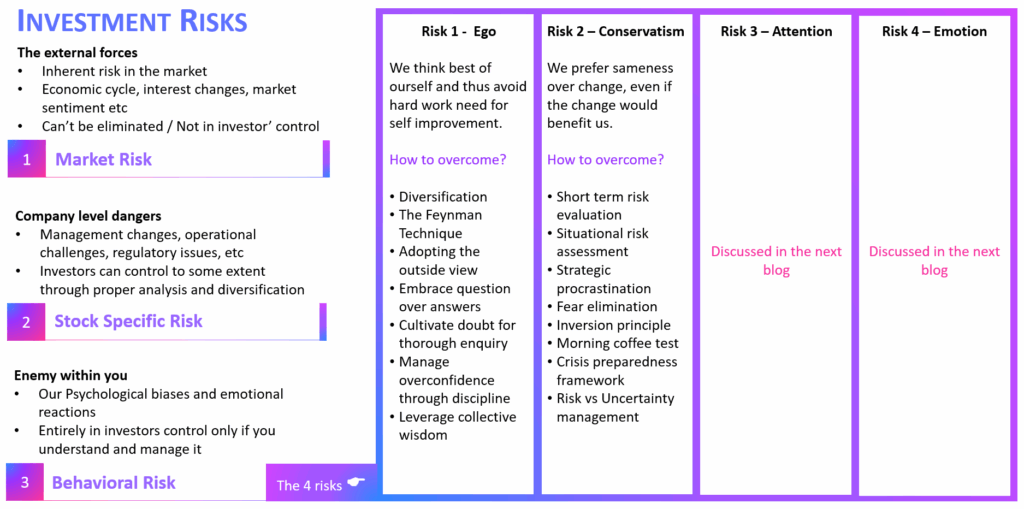
Conquer EGO by building intellectual Humility
Understanding the Root of Ego
Ego is fundamentally rooted in behavior that supports our need for personal competency, often at the expense of logical thinking. This psychological barrier manifests through overconfidence, which is primarily driven by three distinct habits that must be recognized and addressed systematically.
The Three Faces of Overconfidence
- Over-Precision occurs when excessive certainty is placed in the precision of private beliefs, leading investors to narrow their range of possible outcomes unrealistically.
- Over-Placement represents an elevated belief in personal skill relative to others, causing investors to assume they possess superior market insights without objective evidence.
- Over-Estimation involves unrealistic optimism about one’s level of control and odds of success, resulting in inadequate risk assessment and preparation for adverse scenarios.
Proven Strategies for Overcoming Ego
Diversification as Protection
- Portfolio diversification should be implemented not just as a risk management tool, but as a humility exercise.
- While debate continues about optimal stock count, effective diversification typically involves holding 15-25 stocks, with individual positions representing 6-7% of the portfolio to articulate conviction without catastrophic concentration risk.
- Interestingly, the average Indian fund manager holds 54 stocks in their portfolio, which may indicate over-diversification that dilutes returns.
The Feynman Technique
- This is a powerful method that involves identifying knowledge gaps, educating yourself thoroughly, and then teaching the concept to a beginner.
- If complex investment ideas cannot be explained simply, they are likely not fully understood.
- This technique forces investors to confront the depth of their knowledge honestly.
Adopting Outside View
Decision-making should be based more on probability and facts than on convenience and personal experience. This systematic approach involves:
- Selecting a relevant reference class for comparison
- Assessing the distribution of historical outcomes
- Estimating probabilities based on objective data
- Fine-tuning predictions using systematic analysis
Embracing Questions Over Answers
- Markets are inherently uncertain and require dynamic processes.
- Consequently, loving questions rather than seeking definitive answers creates a more adaptive investment mindset.
- This approach prevents premature closure on complex investment decisions.
Cultivating Doubt for Thorough Inquiry
Systematic doubt should be used to stimulate thorough inquiry rather than accepting initial impressions. This skeptical approach leads to more robust investment analysis and better long-term outcomes.
Managing Overconfidence Through Discipline
- Investors much prioritise Continuous learning to maintain intellectual curiosity and stay updated
- Deep analysis must be conducted before making investment decisions—surface-level research is insufficient
- Slow thinking should be practiced—procrastination becomes a valuable tool for better decision-making, allowing emotions to settle and logic to prevail
- Once decisions are made with conviction, position sizing should reflect confidence levels; buying only 2.5% suggests betting against yourself
Leveraging Collective Wisdom
Confirmation bias can be avoided by considering crowd wisdom and seeking diverse perspectives. Collective wisdom proves very powerful in investment decisions. The moment you acknowledge “I don’t know,” a significant psychological barrier has been overcome, opening the door to genuine learning.
Implementing Hegelian Synthesis
Multiple estimates based on different assumptions must be considered. This involves developing a thesis, finding someone to argue the antithesis, and then isolating the best elements from both arguments to create a more robust investment framework. This dialectical approach prevents echo chamber thinking.
(I have read about this approach being done by Warrant Buffett and Charlie Munger. When one comes with an investment idea, the other takes the roles of Devil’s advocate to question the investment rationale of the other.)
Defeat CONSERVATISM by Embracing Calculated Change
The Nature of Conservative Bias
Conservatism is fostered by irrational preferences that favor gain relative to loss and status quo relative to change. Additionally, this bias can be understood as an affinity to privilege our current self over the needs of our future self, a phenomenon known as hyperbolic discounting.
Proven Strategies for Overcoming Conservatism
Long-Term Risk Evaluation
Risk should be evaluated in terms of long-term rewards rather than short-term harm. Behavioral investors often load up on assets like stocks that are perceived as more risky than they actually are when viewed through a long-term lens. This perspective shift transforms apparent risks into opportunities.
Situational Risk Assessment
Risk-taking behavior is more situationally than personally determined. Therefore, investors should avoid fear-inducing situations. The portfolio management processes should be rules-based rather than discretionary to maintain consistency across different market conditions.
Strategic Procrastination
Speed tends to be the enemy of good decision-making and pushes investors towards biased thinking and status quo maintenance. Deliberate delays in decision-making often lead to better outcomes by allowing thorough analysis and emotional equilibrium.
Fear Elimination
The fear of losing—whether through tracking error, career risk, or concentration concerns—must be systematically addressed through proper risk management frameworks. These fears often prevent investors from taking necessary actions for long-term success.
Morning Coffee Test
The “morning coffee test” should be applied—if you wouldn’t be comfortable explaining your investment decision over morning coffee to a friend, it probably needs reconsideration. This simple test reveals uncomfortable truths about investment rationale.
Crisis Preparedness Framework
Decision-making in crisis situations consists of three critical elements:
- Denial,
- Deliberation, and
- Decisive action.
The system implemented is far less important than the discipline to set rules during peaceful times and adhere to them in war times. Preparation during calm markets determines success during volatile periods.
Risk vs. Uncertainty Management
- Risky situations where probabilities are understood lend themselves to logical and statistical thinking.
- However, a clear distinction must be made between risk (where probable outcomes and their probabilities can be defined) and uncertainty (where such definitions are impossible).
- Stock markets particularly hate uncertainty, requiring different approaches for each scenario.
- Behavioral investors tilt probability in their favor over extended periods, reducing uncertainty and improving the probability of achieving correct results for correct reasons.
Conclusion
Overcoming psychological barriers to successful investing requires systematic implementation of proven strategies and unwavering discipline.
We will continue over the next blog to discuss in depth on two other barriers ATTENTION and EMOTION.
Hope you found this blog useful. Do share my blogs with your friends, peers and fellow investors.


